
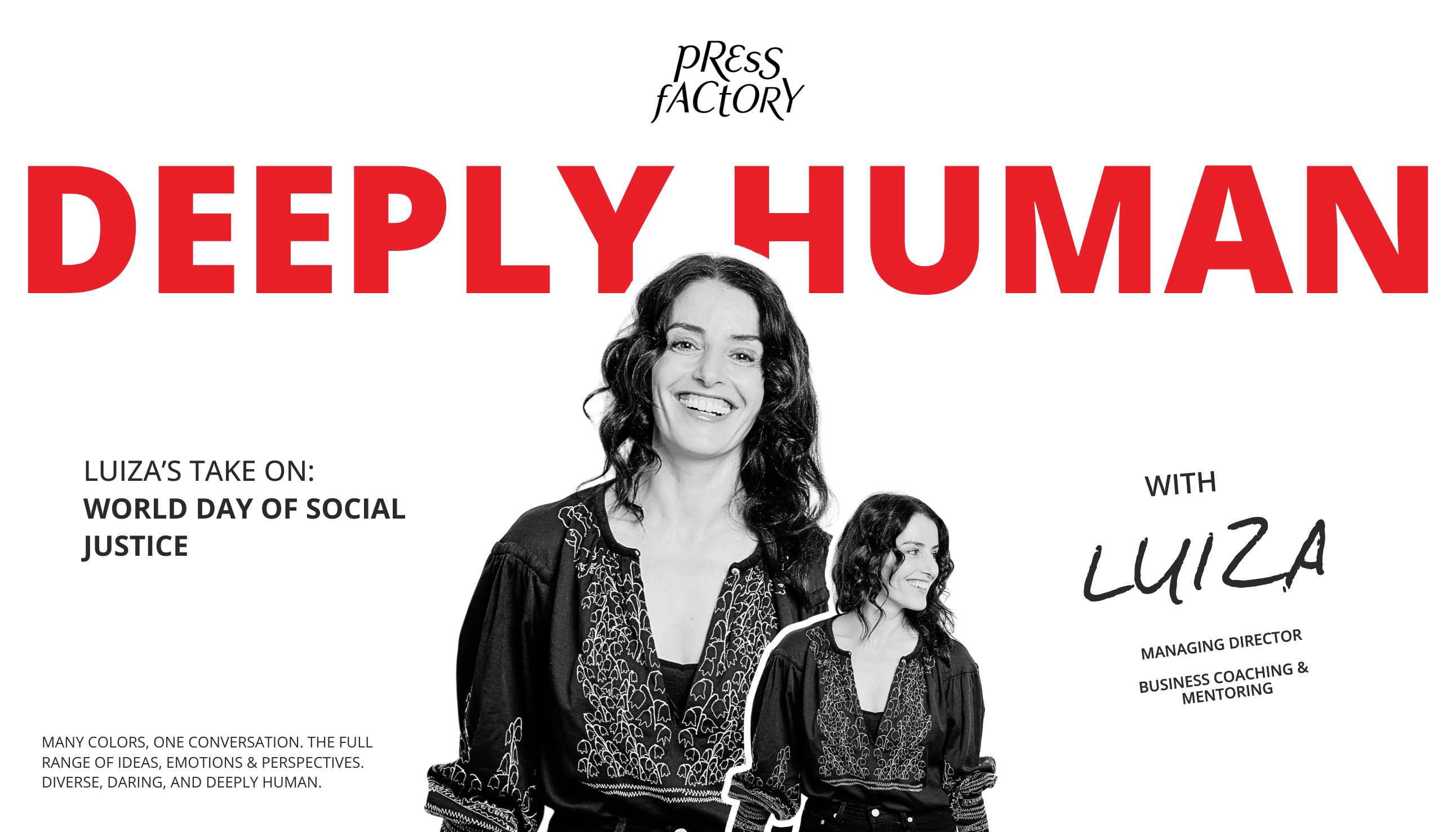
BETWEEN TWO WORLDS AND AT HOME IN BOTH: MY REFLECTIONS ON WORLD DAY OF SOCIAL JUSTICE
Today is World Day of Social Justice, and I’m sitting at my desk in Berlin, looking back on the past 25 years as an entrepreneur. In my mind, I see the little nine-year-old girl from a mountain village in Morocco. That girl probably could never have imagined where she would stand today. And that is exactly why World Day of Social Justice is deeply personal for me and not an abstract concept.
Because no one chooses the country or circumstances they are born into. I was lucky, or was it simply coincidence that my family migrated to Germany? And that coincidence opened up so many opportunities for me, for which I am deeply grateful.
And this is where the question of social justice arises for me:
How many opportunities does each person truly have and how much of it is simply coincidence, or pure luck?
As a Berber in Morocco, and as a Moroccan in Germany, I experienced early on what it means to be different. Different in appearance, different in cultural background, different in the expectations placed on a girl and a woman. I encountered barriers, because of my gender, my origin, my name.
These experiences made me sensitive. Sensitive to what remains unspoken. To people who are not automatically seen, who have to fight harder, who have to be more than others just to be given the same space.
For me, social justice does not mean forcing everyone into sameness. It means fair opportunities and conditions. It means recognizing structural inequalities and taking responsibility, creating spaces for balance and equal access.
What often moves me is precisely this tension between two worlds: on one side, people who have to fight for every single opportunity. On the other side, a society of abundance that gets lost in endless possibilities, and often no longer sees its own privileges.
To me, both are expressions of an imbalance.
That is why social justice also means awareness. The ability to reflect on one’s own position. To be grateful and at the same time remain alert to what is still unjust.
And as a mother of two children, I naturally wish for exactly that: a society in which free personal development does not depend on birthplace, status, religion, skin color, gender, or origin.
For many years, I have led a company with many people of different genders, and my clear values and my background help me greatly: leadership only works for me when it is human. When we are willing to show ourselves authentically with our strengths, but also with our setbacks and imperfections. Vulnerability is not weakness to me, but a form of strength. And that is exactly what we try to live at Press Factory, regardless of role or title.
We speak openly about topics that concern us or bother us. We discuss sometimes uncomfortably. And we encourage one another to look at things with nuance instead of judging too quickly. Just like with this text, which I wrote straight from my heart. It is difficult for me to share it publicly. When I shared it with the team, I was overwhelmed by the feedback. And that is exactly what it’s about for me: what I want to be and show as a role model.
Show yourselves as you are. And as you are, you are right.
That sounds beautiful and simple – but in reality, it is hard work, because it also means truly seeing others, truly listening, and respecting both your own boundaries and those of others.
Because especially in our industry, the creative economy, unpaid overtime, boundary violations, and low fees are unfortunately often considered normal. I have always viewed that critically and consciously decided to do things differently in my company.
Because for me, social justice also means treating people in a way that allows them not only to function, but to grow.
This responsibility is also reflected in the question of which companies I want to work with. We have already turned down major brands, even though they were financially attractive, not out of arrogance, but out of deep conviction. As creatives, we do not only want to shape things, but also question them. We do not deliver quick answers for the moment, we think long, term and provide sustainable solutions that are built to last.
We take responsibility for our work, because we firmly believe that words shape reality and images shape the world. That is what we want to stand for.
And that’s why I also wish for a market economy in which economic success and social responsibility belong together. Germany needs companies that don’t just sell products, but stand up for justice.
My most important appeal on this day: Let us take responsibility.
For the spaces we create. For the people we work with. For the privileges we have. Let us show who we are, with our history, with scars and dreams, with doubts and courage. Because we don’t have to be perfect, not flawless.
And it is a good thing that World Day of Social Justice reminds us that justice is not a state, it‘s a process. One that begins anew every day, in our companies, in our families, in our relationships, and in our decisions.